Transportation Routing Software Solutions: A Complete Guide to Modern Logistics Optimization
In today’s fast-paced world, the movement of goods from one point to another is far more complex than it appears on the surface. Whether you are managing a small local delivery fleet or overseeing a global supply chain, the efficiency of your transportation network directly impacts your bottom line, customer satisfaction, and environmental footprint. This is where transportation routing software solutions come into play. These powerful tools transform how businesses plan, execute, and optimize their logistics operations, turning what was once a manual, time-consuming puzzle into a streamlined, data-driven process.
Think of a delivery truck navigating through a crowded city. Without proper planning, the driver might waste hours in traffic, take inefficient detours, or miss delivery windows. Multiply that by dozens or hundreds of vehicles, and the inefficiencies compound dramatically. Transportation routing software solves this problem by using algorithms, real-time data, and advanced mapping to determine the most efficient paths for each vehicle. It is not just about finding the shortest route—it is about balancing multiple constraints like time windows, vehicle capacity, driver hours, fuel costs, and customer preferences.
What Exactly Is Transportation Routing Software?
At its core, transportation routing software is a digital tool that automates the planning and optimization of vehicle routes. It takes inputs such as delivery addresses, vehicle types, driver schedules, and traffic conditions, and then calculates the best possible sequence of stops. The software can handle thousands of variables simultaneously, something that would be nearly impossible for a human dispatcher to manage manually.
Modern solutions go far beyond simple route plotting. They integrate with GPS tracking, telematics, inventory systems, and customer-facing platforms to provide end-to-end visibility. A dispatcher can see where every truck is in real time, predict arrival times with accuracy, and adjust routes on the fly when unexpected events occur, such as traffic jams or last-minute order changes.
Key Features of Transportation Routing Software
- Route Optimization: Uses algorithms to minimize distance, time, fuel consumption, and operational costs while respecting delivery constraints.
- Real-Time Tracking: Provides live location data for each vehicle, enabling proactive communication with customers and better fleet management.
- Geocoding and Mapping: Converts addresses into precise map coordinates and visualizes routes on interactive maps.
- Schedule Management: Assigns deliveries to specific time windows and balances workloads across drivers.
- Reporting and Analytics: Tracks key performance indicators like on-time delivery rate, cost per mile, and driver productivity.
- Integration Capabilities: Connects with warehouse management systems, enterprise resource planning software, and customer relationship management tools.
Why Transportation Routing Software Matters in Modern Business
Logistics is the backbone of commerce. Whether you run a restaurant that delivers meals, a retail chain stocking shelves, or a freight company moving goods across continents, every mile your vehicles travel costs money and time. According to industry studies, transportation costs can account for a significant portion of a product’s final price. Reducing those costs by even a small percentage can lead to substantial savings.
Beyond cost, there is the matter of customer expectations. In an era of two-day shipping and real-time delivery updates, consumers expect speed and reliability. A package that arrives late or a service visit that misses its window can damage a brand’s reputation. Transportation routing software helps businesses meet these expectations by ensuring that drivers follow optimal paths and arrive on schedule.
Environmental Impact
Sustainability is another compelling reason to adopt routing software. By cutting unnecessary miles and reducing idle time, companies lower their carbon emissions. Many organizations now publish sustainability reports and set ambitious goals for reducing their environmental footprint. Efficient routing is one of the most practical ways to achieve those targets without sacrificing service quality.
How Transportation Routing Software Works: A Step-by-Step Overview
To understand the value of these solutions, it helps to look at how they function in practice. The process typically unfolds in several stages:
- Data Collection: The system gathers information about orders, including pickup and delivery addresses, time windows, package sizes, and special handling requirements.
- Fleet Input: Details about available vehicles, their capacity, fuel type, and driver schedules are loaded into the system.
- Algorithm Processing: The optimization engine analyzes all constraints and generates a set of routes that minimizes total cost while satisfying every requirement. This step might use techniques like genetic algorithms, constraint programming, or machine learning.
- Visualization: Routes appear on a digital map, often color-coded by vehicle, with turn-by-turn directions and estimated arrival times.
- Execution and Monitoring: As drivers follow their routes, GPS data flows back to the system. Dispatchers can monitor progress and intervene if needed.
- Post-Route Analysis: After deliveries are complete, the software generates reports that highlight performance metrics and areas for improvement.
Practical Examples of Transportation Routing Software in Action
Consider a mid-sized beverage distributor that delivers to hundreds of retail locations each week. Before implementing routing software, the company relied on a dispatcher who planned routes based on personal knowledge of the city. Drivers often complained about inefficient sequences, and customers received deliveries at unpredictable times. After adopting a routing solution, the distributor reduced total miles driven by 15%, cut fuel costs by 12%, and improved on-time delivery rates from 78% to 94%.
Another example is a home healthcare agency that sends nurses and aides to patients’ homes throughout the day. Each visit has a specific time window, and the agency must balance travel time with patient needs. Routing software allows the scheduler to assign visits in a way that maximizes the number of patients seen while minimizing drive time. The result is more efficient use of staff hours and better care for patients.
Common Misunderstandings About Routing Software
Despite its benefits, some misconceptions prevent businesses from adopting routing software. One common assumption is that such tools are only for large fleets with dozens of vehicles. In reality, even a single delivery van can benefit from route optimization. The software pays for itself quickly through fuel savings and improved productivity.
Another misunderstanding is that routing software is too complex to set up and use. Modern solutions are designed with user-friendly interfaces, and many offer guided onboarding. Cloud-based platforms require no specialized hardware, and mobile apps make it easy for drivers to follow routes without needing expensive in-vehicle systems.
Some people also believe that routing software eliminates the need for human judgment. While the software handles computation and optimization, experienced dispatchers still play a vital role. They interpret the output, handle exceptions, and make decisions that algorithms cannot, such as accommodating a driver’s personal preference for a particular route.
How Transportation Routing Software Fits into the Broader Technology Ecosystem
Transportation routing software does not exist in isolation. It is part of a larger digital transformation happening across the logistics industry. When combined with other technologies, its impact multiplies.
For instance, Internet of Things (IoT) sensors on vehicles can monitor fuel consumption, tire pressure, and engine health. Integrating this data with routing software allows for predictive maintenance and even more efficient route planning. Similarly, artificial intelligence can analyze historical traffic patterns to predict congestion and recommend alternative routes before a driver even leaves the depot.
Cloud computing has made routing software more accessible than ever. Small and medium-sized businesses can now subscribe to software-as-a-service (SaaS) platforms without large upfront investments. Updates are automatic, and scalability is built in. This democratization of advanced logistics technology means that nearly any company can compete on speed and efficiency, regardless of size.
Choosing the Right Transportation Routing Software for Your Needs
With so many options on the market, selecting the right solution can feel overwhelming. The key is to match the software’s capabilities with your specific operational requirements. Start by asking these questions:
- How many vehicles do I operate?
- What types of constraints matter most (time windows, vehicle capacity, driver hours)?
- Do I need real-time tracking and customer notifications?
- What is my budget for software and implementation?
- Which existing systems (ERP, WMS, CRM) need to integrate?
Once you have clear answers, you can evaluate vendors based on their track record, support quality, and feature set. Most reputable providers offer free trials or demos, allowing you to test the software with your own data before committing.
The Role of Design and Presentation in Routing Software
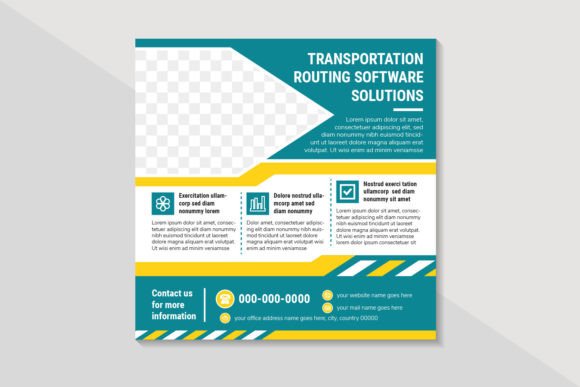
Interestingly, the way routing software is presented to users also matters. This is where the concept of a transportation routing square banner and description abstract social media post banner template design becomes relevant. In marketing these solutions, companies use visually compelling templates, infographics, and social media banners to communicate the value proposition. The template design mentioned in the brief—featuring a half-hexagon space for photo collage, a square layout, and high-resolution vector graphics—is an excellent example of how professional design supports clear communication. When a business showcases its routing software capabilities through such well-organized materials, it builds trust and credibility with potential customers.
These design assets help explain complex features in an accessible way. For instance, an infographic might show how optimization reduces miles or compare before-and-after delivery times. A square banner on social media can highlight a key statistic, such as “25% fewer miles driven” or “99% on-time delivery.” The use of editable shapes, colors, and text means that businesses can customize the template to match their brand identity, making the message both professional and personal.
Conclusion: The Future of Transportation Routing Software
Transportation routing software solutions have moved from being a nice-to-have tool to a critical component of modern logistics. As consumer expectations continue to rise and sustainability becomes a non-negotiable priority, the ability to plan and execute efficient routes will separate leaders from laggards. The technology is not static; it evolves rapidly with advances in AI, real-time data, and connectivity. Businesses that invest now will be better positioned to adapt to future challenges, whether those involve electric vehicle fleets, autonomous driving, or even more complex supply chains.
If you are considering implementing routing software, start by understanding your own operations and goals. Look for a solution that offers the right balance of power and usability. And do not underestimate the importance of clear, professional communication when presenting these tools to stakeholders, customers, or the public. The combination of robust technology and effective design can make all the difference in driving adoption and achieving lasting success.