Retusagi - Powerpoint Template: A Practical Guide to Building Compelling Presentations
Every presentation you create is an opportunity to communicate an idea, persuade an audience, or share data in a way that sticks. But starting from scratch — choosing layouts, matching colors, aligning graphics — consumes hours that could be spent refining your message. The Retusagi - Powerpoint Template addresses exactly this bottleneck. Designed for professionals, creators, marketers, and educators, it provides a complete slide ecosystem that lets you focus on content rather than design mechanics. Here’s how to integrate it into your workflow and get consistent, polished results.
What Retusagi Brings to Your Presentation Workflow
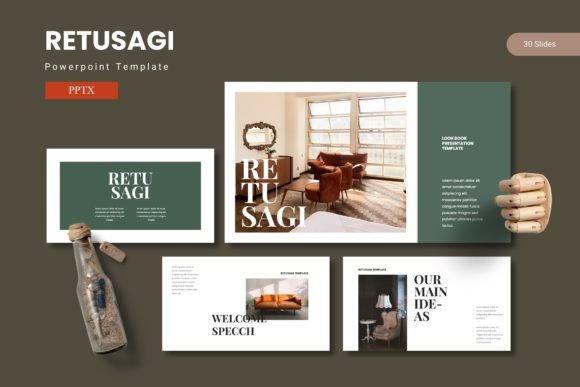
Retusagi is not a single slide deck — it’s a structured system of 150 total slides organized across five distinct color variations. Each color set includes 30 slides, plus section break slides, making it easy to maintain visual consistency across long presentations. The template is built on master slides, so any change you make to a parent slide propagates automatically to all child slides. This feature alone cuts down repetitive adjustments and reduces the risk of inconsistencies creeping in during late-stage edits.
The included handcrafted infographics, pixel‑perfect illustrations, and resizable vector graphics give you a library of assets that can be adapted without losing quality. Picture placeholders support drag‑and‑drop, so adding team photos, product shots, or portfolio images is straightforward. The template also includes gallery and portfolio slide layouts, which are especially useful for creative professionals or businesses showcasing past work.
Because the file comes as five separate PPTX files (one per color scheme), you can pick the palette that fits your brand or project from the start. Inside the folder you’ll also find a Readme file, font information, and image credits — small details that smooth the setup process when working with a team or client.
Before the Presentation: Planning and Asset Preparation
When you’re in the planning phase — defining the narrative, collecting data, or outlining slides — Retusagi helps you visualize the final structure early. Browse the 30 slides per color scheme to see which layouts match your content flow. For example, if you know you need a timeline, a comparison chart, and a portfolio spread, you can bookmark those specific slides and build your outline around them. This reduces the “blank slide” anxiety and gives you a concrete framework to write around.
Because all graphics are editable, you can pre‑customize elements like icons, charts, and color accents to match your brand guidelines before adding actual content. This upfront preparation also makes it easier to delegate slide creation to colleagues — they can work within a consistent template without needing design skills.
During Creation: Drafting and Iterating Efficiently
As you start building the deck, use master slides to maintain uniformity. Adjust the background, font styles, or placeholder positions once, and every slide updates instantly. This is especially helpful when you’re iterating — say, after a stakeholder review that asks for a different color accent or larger image areas. Instead of adjusting each slide individually, you modify the master and the entire deck reflects the change.
The drag‑and‑drop picture placeholders speed up the visual assembly. If you’re incorporating screenshots, photos, or diagrams, simply drop them into the designated areas. The resizable vector illustrations allow you to scale elements without pixelation, which is critical when outputting to high‑resolution screens or printed handouts. For data‑heavy presentations, the handcrafted infographics can be edited to reflect your own metrics, turning raw numbers into visually scannable stories.
After the Presentation: Archiving and Reuse
Retusagi shines as a reusable asset. Once you finish a deck, save the PPTX file as a master for similar future projects. The five color schemes give you flexibility to adjust the tone — use the cooler palette for financial reports, the warmer one for creative pitches. Because the template includes section break slides, you can easily repurpose sections of a longer deck into standalone presentations for different audiences. For example, pull the “Gallery” and “Portfolio” slides from a marketing deck and combine them with a new introduction for a client meeting.
The included font information and Readme file help ensure that anyone who opens the file later — even on a different machine — will see the intended typography. This makes the template a reliable long‑term component of your presentation library.
Practical Implementation Tips
- Start with the Readme. Before diving into slides, read the provided instructions. It explains the master slide setup, how to use the color variations, and where to find linked fonts. Skipping this step often leads to confusion when elements don’t behave as expected.
- Choose a color scheme early. Each of the five PPTX files contains the same 30 slides but with a different color palette. Pick the one that aligns with your brand or the mood of the presentation. You can always swap to another scheme later, but doing it from the start avoids redoing accent adjustments.
- Use section breaks intentionally. The section break slides are designed to create visual pauses between topics. Place them after an introduction, before a case study, or to separate data from discussion. This structure guides the audience’s attention and makes your presentation easier to follow.
- Modify master slides for team consistency. If multiple people are contributing slides, set up the master slides once with your logo, footer, and default fonts. Then share the file. Everyone’s slides will inherit the same base, reducing the need for final alignment checks.
- Resize graphics without fear. Since all illustrations are vector-based, you can scale them as needed. Use this to create custom diagrams or to adjust the visual hierarchy on a slide. For example, enlarge an infographic to be the focal point, or shrink an icon to serve as a secondary visual cue.
- Take advantage of picture placeholders. Instead of manually cropping images to fit shapes, drop your picture into the placeholder. The template auto‑fits it within the designated area. This works well for portfolio grids, team headshots, and product galleries.
- Pair Retusagi with other productivity tools. Use the template inside PowerPoint, but also consider exporting to PDF for client approvals, or using PowerPoint’s export to video if you’re creating a self‑running slideshow. The consistent layouts ensure these outputs remain clean.
Maintaining Quality and Consistency Over Time
One common pitfall when using templates is gradual drift — you swap a font here, change an accent color there, and eventually the deck no longer feels cohesive. Retusagi’s master‑slide architecture works against that tendency. If you or your team ever need to apply a global change, you do it once on the master and every slide updates. Schedule a brief review after each major project to confirm that the template files themselves remain clean and that any custom icons or color adjustments you made are saved within the master slides. This preserves the template’s utility for future presentations.
Another aspect of quality is the readiness of the included resources. The font files and image credits are organized in the folder, so when you hand off the presentation to a designer or client, they have everything they need to edit without hunting for missing assets. This attention to detail matters in professional environments where presentations are often reviewed by multiple stakeholders.
Use Cases Across Different Roles
For marketers and entrepreneurs: Use the portfolio and gallery slides to showcase campaigns, product launches, or client work. The infographics can turn campaign metrics into persuasive visuals for quarterly reviews or investor pitches.
For educators and trainers: The section break slides help divide a lecture into modules. Use the customizable layouts to embed step‑by‑step instructions, diagrams, and summary slides. The picture placeholders are handy for adding screenshots or process images.
For freelancers and small business owners: A consistent brand image builds trust. Choose one color scheme and adapt it for proposals, service overviews, and case studies. The template saves you the cost of hiring a designer for each new deck.
For internal teams and project managers: When creating status reports or project kickoffs, the data‑friendly slide layouts let you combine Gantt charts (using the infographics), KPI dashboards, and bullet‑point summaries without clashing styles.
Long‑Term Value and Final Practical Advice
The Retusagi - Powerpoint Template is built to be used repeatedly, not just for a single presentation. Its five color schemes give you variety without compromising structure. By investing a little time upfront — reading the Readme, setting up master slides, and testing a few layouts — you establish a foundation that makes every future presentation faster and more consistent.
When you’re ready to start, open the folder, browse the included PPTX files, and pick the color that fits your current project. Drop in your content, adjust the infographics to reflect your data, and use the section breaks to guide your narrative. With practice, the template becomes second nature — you’ll think less about formatting and more about the message you want to deliver.
Whether you’re preparing a boardroom pitch, a classroom lecture, or a creative portfolio, Retusagi provides the structure you need to communicate with confidence. The real value isn’t in the slides themselves — it’s in the time and mental energy you reclaim to focus on what matters most: your audience and your ideas.